Luxor East Bank

Luxor Temples: Karnak, Luxor & the Avenue of Sphinxes

The east bank of Luxor holds the two largest temple complexes in Egypt. This guide gives you the optimal strategy for visiting both — including why Karnak at 06:00 and Luxor Temple at dusk is the single best combination in Upper Egypt.

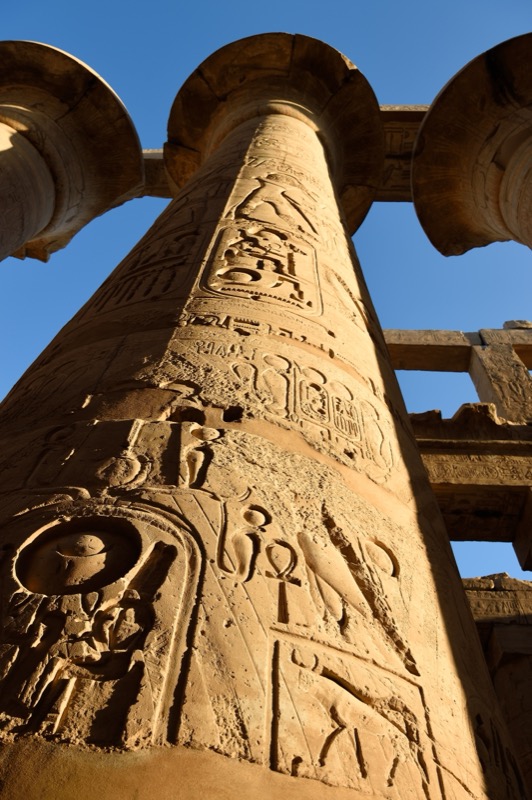
Karnak temple hypostyle hall pillars at early morning light
First Temple — Karnak

Karnak Temple Complex

Karnak is the largest ancient religious site ever built. The complex encompasses roughly 100 hectares — a land area comparable to a small European town — and was continuously constructed, modified, demolished, and rebuilt over approximately 2,000 years from the Middle Kingdom (around 2055 BCE) through the Ptolemaic period (ending 30 BCE). Every pharaoh who ruled Egypt for any significant period left some architectural mark at Karnak.

The primary precinct, dedicated to Amun-Ra, is what visitors access today. It is entered through the First Pylon — a monumental gateway originally 43 metres tall and 113 metres wide, built by later Ptolemaic rulers and never fully completed (one side remains shorter than the other). Beyond it lies the Great Court, the largest temple court in Egypt, before the Second Pylon leads to the Great Hypostyle Hall.

The Great Hypostyle Hall is the single most overwhelming space in ancient Egypt and arguably in the ancient world. One hundred and thirty-four sandstone columns arranged in sixteen rows, the twelve central columns reaching 21 metres and supporting architraves so massive they weigh 70 tonnes each. At its peak the hall was roofed — a vast, dim, forest-like interior lit only by clerestory windows cut high in the side aisles. The roof is long gone, but even in the open air the scale defies easy absorption. Our researchers consistently find visitors stand in near silence here before anyone says anything.

  • Entry EGP 360 adults, EGP 90 students — includes all precincts and the Mut Temple ruins
  • Open daily 06:00–17:30; last admission 17:00
  • Karnak Sound and Light Show (evenings): EGP 250 — covers the route from First Pylon to Sacred Lake with narration and projection
  • Allow 3 hours minimum; 4–5 hours for thorough exploration
  • Golf carts available at main entrance (EGP 80 per circuit, two persons)
Massive sandstone columns of the Karnak Great Hypostyle Hall
On-Site Navigation

What to Prioritise at Karnak

Most visitors focus on the Hypostyle Hall and the First Pylon, then leave without seeing the most historically interesting parts of the complex. This guide covers the essential stops beyond the obvious.

Obelisks of Hatshepsut and Thutmose I

Behind the fourth pylon, two obelisks of Hatshepsut originally flanked the entrance to her festival hall. Only one remains standing — 29 metres of red Aswan granite cut in seven months according to Hatshepsut's own inscription. The low blocks around the base were constructed by her successor Thutmose III to mask the obelisk while allowing it to remain structurally intact — his form of damnatio memoriae without the expense of removal. The story is worth knowing before you look.

Cachette Court (Court of the Seventh Pylon)

In 1903, archaeologists excavating beneath this court discovered one of the most extraordinary caches in Egyptological history — 17,000 bronze figurines and 751 stone statues, buried over centuries by priests when temple storage became full. Today's court is quieter than the Hypostyle Hall but more layered with history. The row of royal statues now lining the south side were recovered from the cachette and returned to near their original positions.

Sacred Lake & Scarab Statue

The Sacred Lake (120 m x 77 m) was used for ritual purification and housed the geese sacred to Amun. The famous giant granite scarab of Amenhotep III stands on its north corner — local tradition holds that walking anticlockwise around it seven times grants a wish. Our researchers have attempted this and report ambiguous results, but it remains a pleasant pause point and one of the better photograph opportunities in the complex.

Open-Air Museum (north of First Pylon)

The Open-Air Museum is accessible with the main ticket and contains reconstructed chapels and smaller structures, including the beautiful White Chapel of Sesostris I (12th Dynasty) — one of the finest examples of Middle Kingdom relief carving surviving anywhere. Many visitors walk past the museum entrance without noticing it. This is where the most delicate and precise craftwork at Karnak can be seen up close.

Second Temple

Luxor Temple

Luxor Temple (Ipet Resyt — "The Southern Sanctuary") was built primarily by Amenhotep III around 1400 BCE and significantly extended by Ramesses II around 1250 BCE. Unlike Karnak, which accumulated structures over two millennia in sometimes chaotic ways, Luxor Temple has a remarkably unified architectural coherence — a processional route from pylon to inner sanctuary that can be followed in a clear, logical sequence.

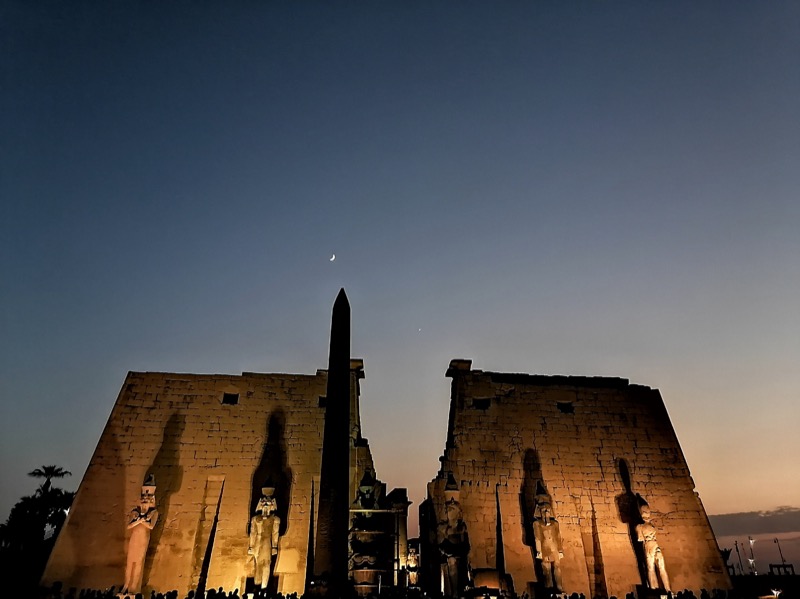
The entrance pylon of Ramesses II features the famous battle scenes of Kadesh on its towers and was originally flanked by six colossal statues (four seated, two standing) of Ramesses II. Two seated statues and one obelisk remain; the companion obelisk was removed in 1836 to Paris, where it stands in the Place de la Concorde. The pylon base inscription of Ramesses II listing his diplomatic marriages and military campaigns is among the most readable in Egypt for non-specialists.

Inside the Great Court of Ramesses II, look for the Abu el-Haggag mosque, which occupies the northeast corner of the court at the level of ancient sand-fill — its floor sits roughly 6 metres above the original temple level, explaining the odd angle of its entrance doorway relative to the street outside. The mosque has operated continuously since at least the 11th century CE and is still an active place of worship — a remarkable 3,400-year span of sacred use on the same site.

  • Entry EGP 260 adults, EGP 65 students
  • Open daily 06:00–22:00 — illuminated after dark (approximately 19:00 onwards)
  • Evening visit particularly recommended: daylight detail plus dramatic lighting
  • Allow 2 hours in daylight, 90 minutes for evening visit
  • Combine with the Avenue of Sphinxes walkable directly from the entrance
Luxor Temple illuminated at night with obelisk silhouette
The Processional Road

Avenue of Sphinxes

One of the most significant recent archaeological restorations in Egypt — a 2.7-kilometre ancient processional road now fully walkable for the first time since antiquity.

The ancient Egyptians called it Waset-Neferu, "the Beautiful" — a 2.7-kilometre processional road connecting Karnak and Luxor temples, lined with sphinx statues (alternately ram-headed, representing Amun, and human-headed) that flanked the ceremonial route used during the annual Opet Festival. At its height the avenue was reportedly lined with 1,350 sphinxes, of which 681 have been recovered and restored to their original positions.

The avenue was gradually buried under centuries of urban development, debris, and the modern city of Luxor. Excavation and restoration began in the 2000s and was completed in 2021 in a major project that involved relocating roads, utilities, and thousands of residents. The newly opened avenue was inaugurated in a grand ceremony in November 2021 and has transformed the visitor experience of Luxor's east bank.

Walking the full avenue from Luxor Temple north to Karnak takes approximately 35–40 minutes at a comfortable pace. It is best done in the late afternoon — north to south into the setting sun, finishing at Luxor Temple as the evening illumination begins. The avenue has no entry fee as it is a public promenade. Sphinxes are protected by low barriers but clearly visible from both sides of the walkway.

The Avenue of Sphinxes leading to Luxor Temple at dusk
Continue Exploring

Luxor's West Bank & Beyond

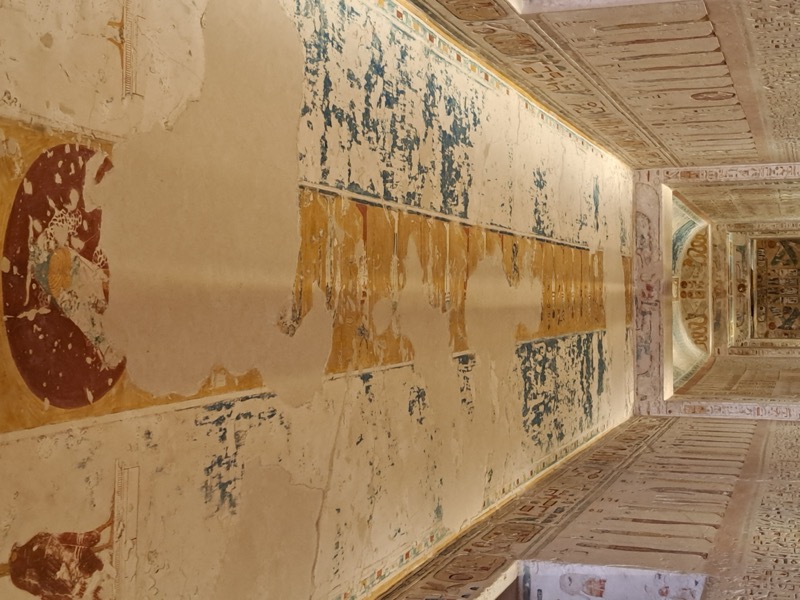
Valley of the Kings entrance path
Luxor West Bank

Valley of the Kings

After the east bank temples, the west bank is the natural second day. Valley of the Kings, Hatshepsut's temple at Deir el-Bahari, and Medinet Habu form a remarkable full-day circuit. Our west bank itinerary guide gives you exact timings and ticket combinations.

West Bank guide ›
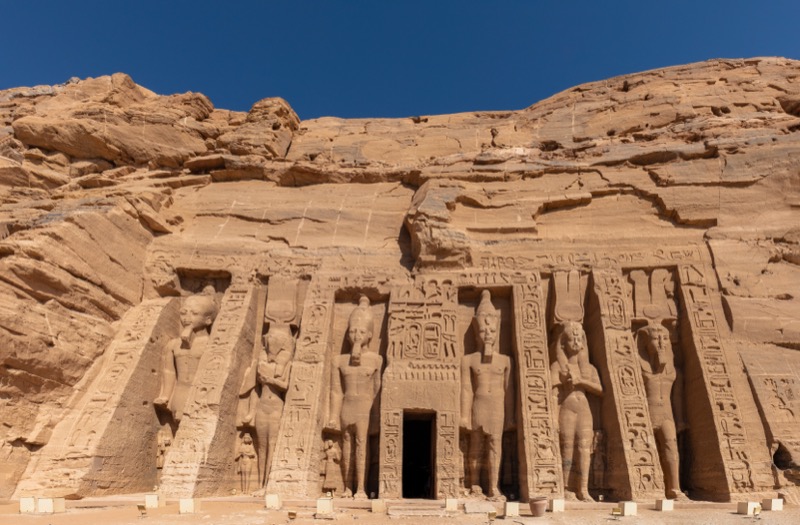
Abu Simbel temple at sunrise
Aswan — 3 hours south

Aswan Highlights

The natural next stop after Luxor is Aswan — reachable by direct train (3–4 hours), overnight sleeper, or the Nile cruise that passes Edfu and Kom Ombo en route. Aswan offers Philae Temple, the Nubian Museum, and the Abu Simbel day trip 280 km further south.

Aswan guide ›
Nile cruise ship at anchor at sunset
Nile Journey

Nile Cruises

The classic way to travel between Luxor and Aswan is by river. The four-day Nile cruise departs Luxor, visits Edfu and Kom Ombo along the way, and arrives in Aswan. Our guide compares large cruise ships with the more intimate and flexible dahabiya sailing vessel option.

Nile Cruises guide ›

Planning Your Luxor Days?

Our Luxor-based researcher Marcus Holden has spent 15 years covering the Theban region. For current site conditions, optimal East and West Bank sequencing, and practical timing advice, send us your dates.

Get in Touch